Fair Use Notice

FAIR USE NOTICE


This site may contain copyrighted material the use of which has not always been specifically authorized by the copyright owner. We are making such material available in an effort to advance understanding of environmental, political, human rights, economic, democracy, scientific, and social justice issues, etc. we believe this constitutes a ‘fair use’ of any such copyrighted material as provided for in section 107 of the US Copyright Law.

In accordance with Title 17 U.S.C. Section 107, the material on this site is distributed without profit to those who have expressed a prior interest in receiving the included information for research and educational purposes. For more information go to: http://www.law.cornell.edu/uscode/17/107.shtml

If you wish to use copyrighted material from this site for purposes of your own that go beyond ‘fair use’, you must obtain permission from the copyright owner.

FAIR USE NOTICE FAIR USE NOTICE: This page may contain copyrighted material the use of which has not been specifically authorized by the copyright owner. This website distributes this material without profit to those who have expressed a prior interest in receiving the included information for scientific, research and educational purposes. We believe this constitutes a fair use of any such copyrighted material as provided for in 17 U.S.C § 107.

Read more at: http://www.etupdates.com/fair-use-notice/#.UpzWQRL3l5M | ET. Updates
FAIR USE NOTICE FAIR USE NOTICE: This page may contain copyrighted material the use of which has not been specifically authorized by the copyright owner. This website distributes this material without profit to those who have expressed a prior interest in receiving the included information for scientific, research and educational purposes. We believe this constitutes a fair use of any such copyrighted material as provided for in 17 U.S.C § 107.

Read more at: http://www.etupdates.com/fair-use-notice/#.UpzWQRL3l5M | ET. Updates

All Blogs licensed under Creative Commons Attribution 3.0

Wednesday, April 20, 2016

The 'Absolutely Disturbing' New Normal: Earth Just Smashed Another Climate Record


Home

Published on
by

The 'Absolutely Disturbing' New Normal: Earth Just Smashed Another Climate Record

'Global temperature records are piling up,' says NOAA
Map: Land and ocean temperature departure from average for March 2016.  (NOAA NCEI)

Our ever-warming planet just passed another climate record.

The National Oceanic and Atmospheric Administration (NOAA) said Tuesday that March 2016 was the warmest March since records began in 1880.

It also marked an 11-month of streak of record-breaking global temperatures.
And at 1.22°C (2.20°F) above the 20th century average of 12.7°C (54.9°F), March 2016 distinguished itself from all 1,635 months on record by having the highest monthly temperature departure. Meteorologists Jeff Masters and Bob Henson wrote, "This is a huge margin for breaking a monthly global temperature record, as they are typically broken by just a few hundredths of a degree. The margin was just a shade larger than NOAA's previous record for any month of 1.21°C (2.18°F) above average, set in February 2016."

NOAA itself noted that "global temperature records are piling up," and said it announced the record warm month "[a]t the risk of sounding like a broken record."
From the Associated Press:
"It's becoming monotonous in a way," said Jason Furtado, a meteorology professor at the University of Oklahoma. "It's absolutely disturbing ... We're losing critical elements of our climate system."
David Karoly, a climate researcher at Melbourne University, told the Sydney Morning Herald, "The extreme temperatures and extreme events, including the coral bleaching in the Great Barrier Reef, are indications that climate change is already happening with worse things in store."

When the Japan Meteorological Agency (JMA) announced its finding last week that March 2016 was the warmest since at least 1891, Michael Mann, a climate scientist and director of the Penn State Earth System Science Center, said the data offered "a reminder of how perilously close we now are to permanently crossing into dangerous territory," and added, "It underscores the urgency of reducing global carbon emissions."

The Washington Post similarly noted Wednesday that, since December when the global talks known as COP21 ended with a carbon emissions-slashing deal, "a drumbeat of grim scientific findings has underscored that staving off the worst consequences of global warming may take far more aggressive actions."

Indeed, a new analysis shows that even if countries implement their pledges laid out in the deal, which is expected to be signed by over 150 nations on Friday, it would result in expected warming by 2100 of 3.5°C (6.3°F)—far past the consensus threshold.

"The fossil fuel industry is pushing our climate to the brink faster than anyone expected, as record temperatures are proving, along with extreme weather related events," said 350.org executive director May Boeve. "We are all at risk from a warming planet, so we are left with no choice but to scale up nonviolent direct action."

Thursday, January 14, 2016

The top ten global warming 'skeptic' arguments answered

The Guardian


The top ten global warming 'skeptic' arguments answered

Contrarian climate scientist Roy Spencer put forth the top 10 'skeptic' arguments - all are easily answered

Thermometer
 Global temperatures are rising, and the top 10 climate contrarian explanations are not good. Photograph: Aaron Tilley for the Guardian


Roy Spencer is one of the less than 3% of climate scientists whose research suggests that humans are playing a relatively minimal role in global warming. As one of those rare contrarian climate experts, he's often asked to testify before US Congress and interviewed by media outlets that want to present a 'skeptical' or false balance climate narrative. He's also a rather controversial figure, having made remarks about "global warming Nazis" and said,
"I view my job a little like a legislator, supported by the taxpayer, to protect the interests of the taxpayer and to minimize the role of government."
In any case, as one of those rare contrarian climate scientists, Spencer is in a good position to present the best arguments against the global warming consensus. Conveniently, he recently did just that on his blog, listing what he considers the "Top Ten Good Skeptical Arguments," throwing in an 11th for good measure. He also conveniently posed each of these arguments as questions; it turns out they're all easy to answer.
1) No Recent Warming. If global warming science is so "settled", why did global warming stop 15 years ago, contrary to all "consensus" predictions?
Quite simply, it hasn't. Even global surface temperatures (which is how Spencer is likely measuring 'global warming', although they only account for about 2% of the Earth's warming), have warmed about 0.2°C over the past 15 years, according to the best available measurements. More importantly, the planet has continued to accumulate heat at a rate equivalent to 4 Hiroshima atomic bomb detonations per second over the past 15 years.
2) Natural or Manmade? If we don't know how much of recent warming is natural, then how can we know how much is manmade?


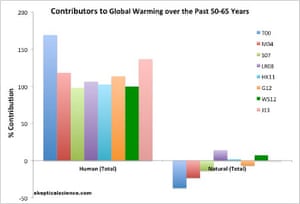
Net human and natural percent contributions to the observed global surface warming over the past 50-65 years according to Tett et al. 2000 (T00, dark blue), Meehl et al. 2004 (M04, red), Stone et al. 2007 (S07, light green), Lean and Rind 2008 (LR08, purple), Huber and Knutti 2011 (HK11, light blue), Gillett et al. 2012 (G12, orange), Wigley and Santer 2012 (WS12, dark green), and Jones et al. 2013 (J12, pink).
 Net human and natural percent contributions to the observed global surface warming over the past 50-65 years according to Tett et al. 2000 (T00, dark blue), Meehl et al. 2004 (M04, red), Stone et al. 2007 (S07, light green), Lean and Rind 2008 (LR08, purple), Huber and Knutti 2011 (HK11, light blue), Gillett et al. 2012 (G12, orange), Wigley and Santer 2012 (WS12, dark green), and Jones et al. 2013 (J12, pink). SkepticalScience.com

The IPCC stated with 95% confidence that most of the global warming since 1950 is human-caused, with a best estimate that 100% is due to humans over the past 60 years. The IPCC was able to draw this conclusion with such high confidence because that's what the scientific evidence and research clearly and consistently concludes.
3) IPCC Politics and Beliefs. Why does it take a political body (the IPCC) to tell us what scientists "believe"? And when did scientists' "beliefs" translate into proof? And when was scientific truth determined by a vote…especially when those allowed to vote are from the Global Warming Believers Party?
The IPCC merely organizes the world's top climate scientists every 5 to 7 years. It's those scientists who summarize the up-to-date status of the scientific research in their respective fields of expertise. The IPCC report and the 97% expert consensus on human-caused global warming are themselves not proof of anything. They summarize and reflect the scientific evidence – that vast body of evidence is the reason the consensus exists.
4) Climate Models Can't Even Hindcast. How did climate modelers, who already knew the answer, still fail to explain the lack of a significant temperature rise over the last 30+ years? In other words, how to you botch a hindcast?
Global surface temperatures have risen more than 0.5°C over the past 30 years. That rise is significant, both in the statistical and figurative sense. Climate models have accurately reproduced that rise.
5) …But We Should Believe Model Forecasts? Why should we believe model predictions of the future, when they can't even explain the past?
Climate models have accurately reproduced the past, but let's put them aside for a moment. We don't need climate models to project future global warming. We know from past climate change events the planet will warm between about 1.5 and 4.5°C from the increased greenhouse effect of a doubling of atmospheric carbon dioxide (the 'climate sensitivity').
In a business-as-usual scenario, atmospheric carbon dioxide levels are expected to surpass 900 ppm by 2100 – that's close to two doublings from the pre-industrial level of 280 ppm. Hence we know that business-as-usual will cause between 2.5 and 7.5°C (most likely 5°C) warming if we stop carbon dioxide levels from rising beyond about 900 ppm. This is based on simple math and what we know about the physics of the climate – no fancy models needed.
6) Modelers Lie About Their "Physics". Why do modelers insist their models are based upon established physics, but then hide the fact that the strong warming their models produce is actually based upon very uncertain "fudge factor" tuning?
Putting aside the accusation that hundreds of climate modelers are all liars – the answer is that their models are indeed based upon well established physics. NASA climate modeler Gavin Schmidt's TED talk on the subject is well worth watching.


Spencer's question likely refers to the uncertain size of the cooling influence of aerosols. However, that is a physical uncertainty. We don't have very good measurements of this effect; unfortunately the rocket carrying NASA's Glory satellite that had instruments to measure the climate effect of aerosols crashed two years ago. Nevertheless, climate models use the available data to account for their influence, and their projections include the associated uncertainties.
7) Is Warming Even Bad? Who decided that a small amount of warming is necessarily a bad thing?
We're headed for about 5°C global surface warming above pre-industrial temperatures by 2100 if we continue on a business-as-usual path. 5°C is the difference between average temperatures now and those during the last ice age. That's not "small" by any stretch of the imagination. As for who decided that amount warming is a bad thing – climate scientists researching the impacts of climate change.
8) Is CO2 Bad? How did carbon dioxide, necessary for life on Earth and only 4 parts in 10,000 of our atmosphere, get rebranded as some sort of dangerous gas?
Carbon dioxide itself is not "bad." Water is also necessary for life. Too much water will kill you. Too much carbon dioxide causes dangerous climate change. Greenhouse gases were determined to be pollutants as defined in the US Clean Air Act . This was a ruling of the (politically conservative) US Supreme Court.
9) Do We Look that Stupid? How do scientists expect to be taken seriously when their "theory" is supported by both floods AND droughts? Too much snow AND too little snow?
This question is a bit like asking, "Do I look fat?". Do you want an honest answer?
The warming of the atmosphere, happening especially at high latitudes, reduces the temperature difference between higher and lower latitudes. This tends to make storms move more slowly. This results in storms dumping more precipitation in localized areas, which causes more flooding in those areas and droughts outside of them. Higher temperatures also increase evaporation, exacerbating droughts and adding more moisture to the air for stronger storms. A climate scientist should understand these concepts.
10) Selective Pseudo-Explanations. How can scientists claim that the Medieval Warm Period (which lasted hundreds of years), was just a regional fluke…yet claim the single-summer (2003) heat wave in Europe had global significance?
There is no contradiction here – a regional event can have global significance, for example via economic impacts. In any case, the Medieval Warm Period was a regional phenomenon and the planet as a whole was cooler than today.
11) (Spinal Tap bonus) Just How Warm is it, Really? Why is it that every subsequent modification/adjustment to the global thermometer data leads to even more warming? What are the chances of that? Either a warmer-still present, or cooling down the past, both of which produce a greater warming trend over time. And none of the adjustments take out a gradual urban heat island (UHI) warming around thermometer sites, which likely exists at virtually all of them — because no one yet knows a good way to do that.
Ironically, most of the adjustments to Spencer's own satellite temperature data set have been in the warming direction, so this question may be an example of psychological projection. Scientists also recently identified a problem in Arctic temperature data analysis that's leading to an incorrect adjustment in the cooling direction, and there have of course been other cooling adjustments in the surface temperature record. The urban heat island effect has also been demonstrated over and over to have no significant influence on the surface temperature record.

Notice a Pattern?

You may have noticed some patterns in these questions. Most are based on false premises and are trivially simple to answer. These 'top ten good skeptic arguments' are frankly not very good or challenging. They also reveal a very one-sided skepticism, although to his credit Spencer did also list 10 'skeptic' arguments that don't hold water. These are glaringly wrong arguments like 'there is no greenhouse effect' and 'CO2 cools the atmosphere,' that some contrarians nevertheless believe. Interestingly, Spencer discusses the science disproving the 10 bad arguments, but there's no scientific discussion supporting his to 'good' arguments.
From reading and answering Spencer's questions, we learn that the basic science behind how we know humans are causing global warming and that it's a problem are quite well-established. There are some remaining uncertainties, like how much warming is being offset by aerosol cooling, but overall we have a very strong understanding of the big picture. For quite a while now we've understood the Earth's climate well enough to know that we can't continue on our current high-risk path.
When will we stop using these trivially wrong contrarian arguments as an excuse for climate inaction? Now that's a tough question to answer.

Thursday, May 14, 2015

The Great Grief: How To Cope with Losing Our World


'To cope with losing our world,' writes Stoknes, 'requires us to descend through the anger into mourning and sadness, not speedily bypass them to jump onto the optimism bandwagon or escape into indifference.' (Photo: Nikola Jones/flickr/cc)

Climate scientists overwhelmingly say that we will face unprecedented warming in the coming decades. Those same scientists, just like you or I, struggle with the emotions that are evoked by these facts and dire projections. My children—who are now 12 and 16—may live in a world warmer than at any time in the previous 3 million years, and may face challenges that we are only just beginning to contemplate, and in many ways may be deprived of the rich, diverse world we grew up in. How do we relate to – and live – with this sad knowledge?

Across different populations, psychological researchers have documented a long list of mental health consequences of climate change: trauma, shock, stress, anxiety, depression, complicated grief, strains on social relationships, substance abuse, sense of hopelessness, fatalism, resignation, loss of autonomy and sense of control, as well as a loss of personal and occupational identity.

This more-than-personal sadness is what I call the “Great Grief”—a feeling that rises in us as if from the Earth itself. Perhaps bears and dolphins, clear-cut forests, fouled rivers, and the acidifying, plastic-laden oceans bear grief inside them, too, just as we do. Every piece of climate news increasingly comes with a sense of dread: is it too late to turn around? The notion that our individual grief and emotional loss can actually be a reaction to the decline of our air, water, and ecology rarely appears in conversation or the media. It may crop up as fears about what kind of world our sons or daughters will face. But where do we bring it? Some bring it privately to a therapist. It is as if this topic is not supposed to be publicly discussed.

This Great Grief recently re-surfaced for me upon reading news about the corals on the brink of death due to warming oceans as well as overfishing of Patagonian toothfish in plastic laden oceans. Is this a surging wave of grief arriving from the deep seas, from the ruthlessness and sadness of the ongoing destruction? Or is it just a personal whim? As a psychologist I’ve learned not to scoff at such reactions, or movements in the soul, but to honor them.

A growing body of research has brought evidence from focus groups and interviews with people affected by droughts, floods, and coastal erosion. When elicited, participants express deep distress over losses that climate disruptions are bringing. It is also aggravated by what they perceive as inadequate and fragmented local, national and global responses. In a study by researcher  Susanne Moser on coastal communities, one typical participant reports: “And it really sets in, the reality of what we're trying to hold back here. And it does seem almost futile, with all the government agencies that get in the way, the sheer cost of doing something like that – it seems hopeless. And that's kind of depressing, because I love this area.” In another study by sociologist Kari Norgaard, one participant living by a river exclaims: “It’s like, you want to be a proud person and if you draw your identity from the river and when the river is degraded, that reflects on you.” Another informant experiencing extended drought explained to professor Glenn Albrecht’s team that even if “you’ve got a pool there – but you don’t really want to go outside, it’s really yucky outside, you don’t want to go out.”

A recent climate survey by the Yale Project on Climate Change Communication and the George Mason University Center for Climate Change Communication had this startling statistic: “Most Americans (74%) say they only ‘rarely’ or ‘never’ discuss global warming with family and friends, a number that has grown substantially since 2008 (60%).” Emphasis mine.

These quotes and statistics underscore the reality that many prefer to avoid or not dwell in—this Mordor-esque land of eco-anxiety, anger, despair, and depression. One of denial’s essential life-enhancing functions is to keep us more comfortable by blotting out this inner, wintry darkness.

The climate survey, however, also has this encouraging finding: “Americans are nine times more likely to lean toward the view that it is people’s responsibility to care for the Earth and its resources (62%) than toward the belief that it is our right to use the Earth and its resources for our own benefit (7%).”

So, what if instead of continuing to avoid this hurt and grief and despair, or only blaming them—the corporations, politicians, agrobusinesses, loggers, or corrupt bureaucrats—for it, we could try to lean into, and accept such feelings. We could acknowledge them for what they are rather than dismissing them as wrong, as a personal weakness or somebody else’s fault. It seems, somehow, important to persist and get in touch with the despair itself, as it arises from the degradation of the natural world. As a culture we may uncover some truths hinted at by feelings we tend to discredit as depressive. These truths include that they accurately reflect the state of ecology in our world. More than half of all animals gone in the last forty years, according to the Living Planet Index. Most ecosystems are being degraded or used unsustainably, according to Millennium Assessment Report. We’re living inside a mass extinction event, says many biologists, but without hardly consciously noticing.

In order to respond adequately, we may need to mourn these losses. Insufficient mourning keeps us numb or stuck in anger at them, which only feeds the cultural polarization. But for this to happen, the presence of supportive voices and models are needed. It is far harder to get acceptance of our difficulty and despair, and to mourn without someone else’s explicit affirmation and empathy.

Contact with the pain of the world, however, does not only bring grief but can also open the heart to reach out to all things still living. It holds the potential to break open the psychic numbing. Maybe there is also community to be found among like-hearted people, among those who also can admit they’ve been touched by this “Great Grief,” feeling the Earth’s sorrow, each in their own way. Not just individual mourning is needed, but a shared process that leads onwards to public re-engagement in cultural solutions. Working out our own answers as honestly as we can, as individuals and as communities, is rapidly becoming a requirement for psychological health.

To cope with losing our world requires us to descend through the anger into mourning and sadness, not speedily bypass them to jump onto the optimism bandwagon or escape into indifference. And with this deepening, an extended caring and gratitude may open us to what is still here, and finally, to acting accordingly.
Per Espen Stoknes is a psychologist, an economist, and an entrepreneur who has cofounded clean-energy companies. He spearheads the BI Norwegian Business School’s executive program on green growth. He has written three books, including What We Think About When We Try Not To Think About Global Warming. He lives in Oslo, Norway.

Thursday, March 26, 2015

The Megadrought is Coming: Climate Scientists Predict Decade Long Droughts For Much of America

Daily Kos


THU FEB 12, 2015 AT 01:31 PM PST

The Megadrought is Coming: Climate Scientists Predict Decade Long Droughts For Much of America


bySteven DFollow


Don't shoot the messenger, folks.  
A recent research article published in the online journal Science Advances by 2050 major portions of the Southwestern and Great Plains states will suffer from droughts much, much worse than the ones we have seen over the last 15 years.  If you think things are at a crisis point, now, just wait.  According to the researchers:
[A]n empirical drought reconstruction and three soil moisture metrics from 17 state-of-the-art general circulation models to show that these models project significantly drier conditions in the later half of the 21st century compared to the 20th century and earlier paleoclimatic intervals. This desiccation is consistent across most of the models and moisture balance variables, indicating a coherent and robust drying response to warming despite the diversity of models and metrics analyzed. Notably, future drought risk will likely exceed even the driest centuries of the Medieval Climate Anomaly (1100–1300 CE) in both moderate (RCP 4.5) and high (RCP 8.5) future emissions scenarios, leading to unprecedented drought conditions during the last millennium.
Let's put that in non-specialist terms, shall we.  
The coming drought age – caused by higher temperatures under climate change – will make it nearly impossible to carry on with current life-as-normal conditions across a vast swathe of the country.
The droughts will be far worse than the one in California – or those seen in ancient times, such as the calamity that led to the decline of the Anasazi civilizations in the 13th century, the researchers said.
“The 21st-century projections make the [previous] mega-droughts seem like quaint walks through the garden of Eden,” said Jason Smerdon, a co-author and climate scientist at Columbia University’s Lamont-Doherty Earth Observatory.
When someone starts talking about mega droughts that would dwarf any ever experienced in the region in nearly a thousand years, I sit up and take notice.  And just to be clear, the droughts in the region during the Medieval era were significant, and likely were a major contributor to the end of one of the longest lasting Pre-Columbian civilizations in the Americas, the "Ancient Pueblo peoples" Anasazi.
For those of you unfamiliar with the "Ancient Pueblo peoples" Anasazi, its civilization in what is now the Southwestern United States lasted for over a thousand years, from at least 100 B.C.E. (some scholars place them in the area as early as 1500 B.C.E.) until roughly 1300 C.E. Their pueblo communities extended throughout the mountains, mesas and grasslands of Southwestern Colorado, Southeastern Utah, Northern New Mexico and Arizona. The most famous of their cliff dwelling sites are ruins found in Mesa Verde National Park.  
Their civilization, based on a mix of dry land farming, hunting and trade in pottery goods collapsed sometime around 1300 C.E. in part due to a series of severe droughts that hit the region following a large increase in their population between 700 B.C.E. and 1100 B.C.E. when rainfall patterns were above average for an extended period of time. The loss of water resources was a major factor in their abandonment of their pueblo communities, along with other stresses believed to include including competition from peoples migrating into their traditional range, and increased warfare among various groups of Ancient Pueblo peoples Anasazithemselves.  
Nonetheless, there is little doubt of the severity of the droughts the region endured during that time.  
New tree-ring records of ring-width from remnant preserved wood are analyzed to extend the record of reconstructed annual flows of the Colorado River at Lee Ferry into the Medieval Climate Anomaly, when epic droughts are hypothesized from other paleoclimatic evidence to have affected various parts of western North America. The most extreme low-frequency feature of the new reconstruction, covering A. D. 762-2005, is a hydrologic drought in the mid-1100s. The drought is characterized by a decrease of more than 15% in mean annual flow averaged over 25 years, and by the absence of high annual flows over a longer period of about six decades. The drought is consistent in timing with dry conditions inferred from tree-ring data in the Great Basin and Colorado Plateau
So, how extreme will be these mega droughts that are being predicted for much of the Western United States, including the regions that provide most of the crops we produce?  Pretty damn severe, in the nature of apocalyptic severity.  That is not hyperbole from me.  It's what the scientists are saying about our future prospects:
Eugene Wahl, a paleoclimatologist at the National Oceanic and Atmospheric Administration in Boulder, Co., called the results "stunning."
"It is clear that they are seeing drought, especially in the Southwest, as being greater than any time in the past," Wahl said. "It is also clear that it is the higher temperatures in the future that is driving it." [...]
According to the new research, droughts in the Southwest and Central Plains will only worsen during the second half of this century. The closest comparison is to the 1930s Dust Bowl or 1950s drought, but lasting 35 years instead of just a few.
"Our results point to a markedly drier future that falls far outside the contemporary experience of natural and human systems in Western North America, conditions that may present a substantial challenge to adaptation," the authors write.
We are talking about extreme drought conditions that will extend from the Mississippi River to California that will last for thirty, forty or more years, literally leave our highly populated, water dependent society in uncharted territory, threatening our civilization's ability to adapt to what will be  a radically altered future environment.
No one knows what megadroughts, which can last from 30-50 years, look like. So researchers from NASA and Columbia and Cornell Universities went back 1,000 years to peer confidently into our drier future.
“Our results show it’s very likely, if we continue on our current trajectory of greenhouse gas emission and warming, that regions in the west will be drier at the end of the 21st century than the driest centuries during the Medieval era,” Cook told Quartz.
But just how likely is very likely? The study puts the chances of a megadrought in the central plains and southwest sometime between 2050-2099 at above 80%. That’s compared with just a 5-10% risk from 1950-2000. Even the milder emissions scenario predicts drying comparable to a Medieval-style megadrought in many locations. “This really represents a fundamental shift in the climate in western North America forced by these greenhouse gases—it’s a shift towards a much drier baseline than anything that anyone alive today has experienced,” said Cook. [...]
When asked how a megadrought, if it started today, would affect in the West, Famiglietti said that public water, aquifers, agriculture, rangelands, wildlife and forests would all be at risk. He added: “In California, we’re already in deep trouble. Imagine what the water situation will look like in 2075?  Depleted groundwater, decimated agriculture, irreparable damage to ecological habitat. Think apocalypse.”
He’s recently written about the water crisis in California, where he imagined the state as a “disaster movie waiting to happen.” After reading the new study, he told Quartz that it “presents a real doomsday scenario and a situation that is far worse than anything that I had been thinking about.”
That is a very frightening thought, particularly since our political and business leaders seemed to be doing their best to ignore or deny the existence of this threat. If we want our children and grandchildren to have any kind of hope for a sustainable future, one that does not risk total societal collapse, we need to change the way in which our nation currently functions at all levels.  Political goals, economic policy and cultural valuers all must change, and that change cannot come soon enough.  The current devastation and economic disruption caused by the droughts out West are just a taste of what is to come.
“We need to be thinking about intensifying drought and bringing it into our planning, but I think there are also a lot of opportunities, but it’s going to take more cooperation and more coordination to face the uncertainty of the future,” he told Quartz. “We can’t continue the status quo.”

Wednesday, November 12, 2014

10 Things You Need to Know About the U.S.-China Climate Deal


bmckibbenbw1

Last night, just weeks after the largest climate mobilization ever, the world’s two biggest polluters—the U.S. and China—announced their most ambitious climate action yet. That is not a coincidence: it’s a sign that our pressure is working, and that we need to apply much more.

uschinaflags
The announcement today is an achievement for everyone who’s held a banner, signed a petition and gone to jail—and a call for many more to join us going forward!

Here’s my take on what the just-announced plan from President Obama and Premier Xi is, and isn’t:

1. It is historic. John Kerry was right to use the phrase in his New York Times oped announcing the deal: for the first time a developing nation has agreed to eventually limit its emissions. This is a necessity for advancing international climate negotiations.

2. It isn’t binding in any way. In effect President Obama is writing an IOU to be cashed by future presidents and Congresses (and Xi is doing the same for future Politburos). If they take the actions to meet the targets, then it’s meaningful, but for now it’s a paper promise. And since physics is uninterested in spin, all the hard work lies ahead.

3. It is proof—if any more was needed—that renewable energy is ready to go. The Chinese say they’ll be using clean sources to get 20 percent of their energy by 2030—which is not just possible, it should be easy. Which they know because they’ve revolutionized the production of solar energy, driving down the cost of panels by 90 percent or more in the last decade.

4. It is not remotely enough to keep us out of climate trouble. We’ve increased the temperature less than a degree and that’s been enough to melt enormous quantities of ice, not to mention set the weather on berserk. So this plan to let the increase more than double is folly—though it is good to see that the two sides have at least agreed not to undermine the 2 degrees Celsius warming target, the one tiny achievement of the 2009 Copenhagen conference fiasco.

5. It is a good way to put pressure on other nations. I’ve just come back from India, which has worked hard to avoid any targets of any sort. But the lesson from this pact is, actual world leaders at least need to demonstrate they’re talking about climate; it makes the lead-up to the global negotiations in Paris next year more interesting.

6. It is a reason projects like Keystone XL and fracking make even less sense than ever. If President Obama is serious about meeting these kinds of targets, then we need serious steps; the surest way to undermine this commitment would be to approve new pipelines or authorize other new fossil fuel developments like fracking. If you pledge sobriety and then buy a keg of beer, people are going to wonder.

7. It is another reminder that it is past time to divest from fossil fuels. The burgeoning divestment movement has been arguing not just on moral grounds, but also making the point that the future will inevitably lead to a downsloping curve for the old energies. This is another warning—for anyone who looks more than a few quarters out, the writing is on the wall that the fossil fuel era is on its way out.

8. It’s not, in any way, a stretch goal. These numbers are easy—if you were really being cynical, you could say they’re trying to carefully manage a slow retreat from fossil fuels instead of really putting carbon on the run. The Germans, for instance, will be moving in on 60 percent of their energy from clean sources by the mid-2020s, when we’ll still be cutting carbon emissions by small increments.

9. It is—and this is the real key—a reminder that movements work. President Obama first endorsed the 80 percent by 2050 goal he enshrined in this pact when he was running for president in 2007, a week after 1,400 demonstrations around the nation demanded that goal. This comes seven weeks after by far the largest global climate demonstrations in history, and amidst ongoing unrest in China about the filthy air in its cities.

10. It isn’t, in other words, a reason to slack off one bit in the ongoing fight for a livable climate, a fight we must continue at all cost. If we want this to be a start, and not a finish, we’ve got to build even bigger and more powerful movements that push the successors of these gentlemen to meet what science demands.

Today is an achievement for everyone who’s held a banner, signed a petition and gone to jail—and a call for many more to join us going forward!

The U.N. Just Released Its Final Report on Climate Change—and It’s Terrifying


The U.N. Just Released Its Final Report on Climate Change—and It’s Terrifying

The IPCC says we need to stop burning fossil fuels by 2100.

(Photo: Hans-Peter Merten/Getty Images)
November 02, 2014
Kristina Bravo is Assistant Editor at TakePart. 


Science has spoken: Fossil fuels should be phased out by the end of the century.

The United Nations’ Intergovernmental Panel on Climate Change on Sunday released the final installment of its four-part assessment, published over the past 13 months. The report, which draws on the analysis of 800 scientists, will serve as a guideline for government officials to come up with a global treaty on climate by 2015.

According to the grim conclusion, the planet will face “severe, pervasive and irreversible” damage if we don’t switch to zero- and low-carbon sources of electricity by 2100. Humans and ecosystems could suffer unprecedented losses from more severe and frequent weather events.

What can we do? The report suggests that we grow our use of renewable energy from its current 30 percent share of the power sector to 80 percent by 2050. Combined with technological and structural change, “behavior, lifestyle and culture” could have a considerable impact.

“We have the means to limit climate change,” IPCC chairman Rajendra Pachauri said at the launch of the report in Copenhagen. “All we need is the will to change, which we trust will be motivated by knowledge and an understanding of the science of climate change.”

In the United States, President Obama has pledged to battle climate change and has proposed cutting carbon emissions from power plants by 30 percent by 2013. But the results of the midterm election could hamper similar efforts. The GOP, notorious for challenging climate science, is expected to take control of the Senate.

“If Republicans take back the Senate, I don’t see there being a lot of willingness to allow the administration to cede any authority to the U.N. on climate policies or elsewhere, and I don’t really think that kind of a position will hurt us politically going into 2016,” a Senate GOP aide told the Washington Examiner.
Secretary of State John F. Kerry, in his comment on the IPCC’s report, said that government officials need to act beyond politics.

“We can’t prevent a large-scale disaster if we don’t heed this kind of hard science,” he said in a statement. “The longer we are stuck in a debate over ideology and politics, the more the costs of inaction grow and grow. Those who choose to ignore or dispute the science so clearly laid out in this report do so at great risk for all of us and for our kids and grandkids.”
 

Monday, November 10, 2014

Why Climate Scientists Receive Death Threats


Why Climate Scientists Receive Death Threats

| November 10, 2014 9:19 am |
 
 
If you don’t like the message on climate change, it seems that the answer is to shot the messenger.

According to a new book by veteran environmentalist George Marshall, thousands of abusive emails—including demands that he commit suicide or be “shot, quartered and fed to the pigs, along with your family”—were received by climate scientist Michael Mann, director of Pennsylvania State University’s Earth System Science Centre, who drew and published the “hockey stick graph” that charts a steep rise in global average temperatures.


bookcovercc


Glenn Beck, a commentator on Fox TV, called on climate scientists to commit suicide. A climate denial blogger called Marc Morano claimed that one group of climate scientists deserved “to be publicly flogged.” And the late Stephen Schneider found his name and that of other Jewish climate scientists on a “death list” maintained by an American neo-Nazi website.

Very Strange

As Marshall points out in his absorbing, all-embracing, immensely readable book, Don’t Even Think About It: Why Our Brains are Wired to Ignore Climate Change, something very strange is going on.

Louis Pasteur’s revolutionary microbiology work on disease prevention never resulted in him having to think about how to use a gun. Jonas Salk never needed to fortify his house as result of working on the development of a polio vaccine.
Other scientists are trusted and respected. But the way climate scientists are now treated, Marshall argues, is without parallel in the history of science: “They have been set up to play that role in a climate storyline that, it would seem, cannot refute climate change without demonising the people who warn us about it.”

Forget, if you can, the people who seem to be whipping up these furious responses. Climate change can only be met or mitigated by action—and there are plenty of reasons why a very large number of people nod in agreement about what must be done and then fail to insist that it is done.

Dan Gilbert, a psychologist who won the Royal Society’s science book prize in 2007 with an examination of the puzzles of happiness, says that climate change is something unlikely to strike fear in the human heart anyway. It is impersonal, it is gradual, it is amoral and it isn’t—or doesn’t seem to be—happening now.
Other researchers have pointed out the alarming tendency, shared by all humans, to believe what they want to believe. Furthermore, climate change is not (death threats and public flogging fantasies aside) an immediate or an emotional issue. “A distant, abstract, and disputed threat just doesn’t have the necessary characteristics for seriously mobilising public opinion,” says the Nobel laureate, Daniel Kahneman.

There are other difficulties. When, for instance, will the awful things start to happen? How do you mobilise public opinion on an argument with uncertain timescales, imprecise outcomes and real puzzles about the costs and benefits of any actions? No one, Marshall says, is ever going to march under a banner of that says “100 months before the Odds Shift into a Greater Likelihood of Feedbacks.”

Marshall founded the Climate Outreach and Information Network (COIN), based in Oxford, England. He is a veteran of Greenpeace and the Rainforest Foundation, and there isn’t much doubt about what he thinks and knows to be true.

But the appeal of this book is that he lets others talk. He examines the political doublethink that seems to infect some legislatures in the U.S. He listens to the skeptics, the worriers, the oil giants, the conspiracy theorists, the celebrity environmental campaigners and the other ones who invoke imagery of death, fever and smoking ruin.

And he refers to the University of Oxford’s Future of Humanity Institute, which polled academic experts on global risk, and found an estimate of a “19 percent probability that the human species will go extinct before the end of the century”.

Altruistic Behavior

The title, direction and burden of this book seem to augur almost apocalyptic failure to confront the coming crisis. But, of course, Marshall pulls out an ace near the end.

He concludes that while human brains may be hard-wired to not worry about what may or may not happen in two generations, they also have an immense capacity for pro-social, supportive and altruistic behavior.
“Climate change is entirely within our capacity for change,” he says, “It is challenging, but far from impossible.”

That is good to know. And the book ends with some serious advice about how to make the case for action—and instead of capital punishment, we get generously shouty advice in capital letters. CLIMATE CHANGE IS HAPPENING HERE AND NOW, he reminds us. And he urges campaigners to DROP THE ECO-STUFF, especially the polar bears.

Marshall suggests that we really do try to contain global average warming to 2°C. He quotes John Schellnhuber, director of the Potsdam Institute for Climate Impact Research, who told the Australians: “The difference between two and four degrees is human civilization.” And, yes, do think about it.